
Aeroponics vs Hydroponics vs Soil — Which Home-Growing System Should You Choose in 2025?

Updated: Dec 19, 2025
The Quick answer: For most urban Indian homes in 2025, aeroponics is the best choice if you want fastest growth, lowest water use and minimal space — hydroponics is best for beginners on a budget or larger crops, and soil remains ideal for terraces and full-sized vegetables.
Introduction
As city homes shrink and shoppers look for chemical-free food, many ask: “Hydroponics vs aeroponics — which is better for my apartment?” This guide answers that question and compares aeroponics vs hydroponics vs soil so you can pick the best home gardening system 2025 for your needs. Read the quick comparison below, then jump to the section that fits you — budget beginners, small apartments, terrace gardeners or tech-minded professionals.
Urban gardening is becoming a lifestyle choice; more people are exploring smarter ways to grow their own food. With pollution, pesticide-heavy vegetables, and shrinking home spaces, soil-free systems like hydroponics and aeroponics are trending in India.
This expanded guide compares all three systems — Soil, Hydroponics, and Aeroponics — helping you choose the right one for your home in 2025.

Who is this guide for?
Home growers choosing between soilless and soil methods — whether you want low-maintenance indoor food, the fastest growing gardening system, or a budget starter for kitchen gardening in India.
Soil Gardening (Terraces & Backyards) — Pros, Cons & When to Choose Soil
Soil gardening (best for terraces & open spaces): Soil is the traditional method — cheap and low-tech, but needs space and time.
Pros
Very affordable startup costs.
Works for almost all plant types (trees, vegetables, flowers).
Natural ecosystem — less tech knowledge needed.
Cons
Slowest growth and lower yields per square foot.
Requires space, sunlight and regular watering.
Pests and soil diseases are common.
Not ideal for small apartments as it may be messy and unpredictable.
Best for: terrace gardens, larger family plots and growers who prefer low-tech solutions.

Hydroponics for Home — What It Is, Pros & Cons
Hydroponics (best for beginners who want soil-free growing)
Hydroponics grows plants with nutrient solution and inert media or NFT channels.
Pros
Faster growth than soil; good yields.
Clean, organized indoor setups; works with grow lights.
Lower pest risk than soil.
Cons
Needs pumps, periodic water changes and pH/EC monitoring.
Risk of algae and reservoir-borne pathogens if not cleaned.
Moderate maintenance requirements including cleaning grow media.
Best for: beginners who want a forgiving, affordable soil-free system like DWC, NFT or drip.

Aeroponics for Apartments — Why It’s the Fastest Growing Gardening System
Aeroponics (best for apartments, fastest harvests)
Aeroponics suspends roots and sprays a fine nutrient mist. It’s the most space-efficient option, maximizes oxygen exposure and boosts growth rates..
Pros
Fastest growth rates — excellent oxygen exposure at roots.
Delivers the fastest growth rates.
Uses ~90–95% less water than soil; very clean.
Low footprint — perfect for balconies, corners and kitchens.
Very low pest risk.
Cons
Higher initial cost for quality towers and pumps.
Requires reliable power and occasional nozzle maintenance.
Cheap pumps/nozzles fail — choose good hardware.
Best for: apartment growers who want quick leafy harvests and minimal footprint.

Scientific Comparison — Why Aeroponics Wins
Scientific comparison — why aeroponics often win for urban homes
Oxygen at the roots: Aeroponics suspends roots and mists them — roots get far more oxygen than in typical hydroponic reservoirs. More oxygen = faster nutrient uptake = faster growth.
Water efficiency: Well-built aeroponic towers use 90–95% less water than soil (recirculating systems). That’s ideal for Indian apartments and water-tight budgets.
Space efficiency: Vertical aeroponic towers can host 20–40 plants per sq. ft. in a stacked layout — perfect for balconies and living rooms.
Disease containment: Because roots aren’t submerged in one big reservoir, cross-contamination risk is lower if you maintain nozzles and water regularly.
Quick Comparison — Hydroponics vs Aeroponics vs Soil
Feature | Soil | Hydroponics | Aeroponics |
Growth speed | Slow | 1.5–2× soil | 2–5× soil |
Water use | High | Medium (≈50% less than soil) | Lowest (≈90–95% less than soil) |
Space needed | Large | Medium | Very low (vertical towers) |
Maintenance | High (pests, soil care) | Medium (pump, water changes) | Low-medium (nozzles, water testing) |
Cost (initial) | Low | Medium | Medium-High |
Best for | Open terraces, full beds | Beginners, larger crops | Apartments, quick leafy harvests |
Crop Suitability — What You Can Grow
Fastest winners (7–21 days): Microgreens, baby lettuce mixes.
Quick leafy greens (3–5 weeks): Lettuce, spinach, pak choi, coriander.
Herbs (3–6 weeks): Basil, mint, parsley, chives.
Fruiting (longer): Cherry tomatoes, strawberries, chillies (need support and more attention).
Soil: Suitable for all plants — vegetables, flowers, trees.
Hydroponics: Best for leafy greens and herbs.
Aeroponics: Ideal for leafy greens, herbs, strawberries, tomatoes, chillies, capsicum, and more.

Buying Guide — Best Home Gardening System 2025 (products & what to look for)
How to pick a home system (3 checks)
Space & location — measure where you’ll put the unit; towers are best for corners and kitchens.
Power reliability — if you have frequent outages, pick hydroponics/soil or a tower with a battery backup.
Maintenance comfort — if you want <10 minutes/week, choose an automated aeroponic tower with pre-programmed cycles.
Top picks for 2025:
Nova 20(small) — best starter tower for herbs.
Nova 40 (mid) — best value for leafy greens and small fruiting plants.
Lotus 60 (premium) — best for families who want higher capacity and smart LED.
Cost Breakdown (Detailed)
Estimated Costs: Soil vs Hydroponics vs Aeroponics (India, 2025)
System | Initial Setup Cost | Ongoing Costs (Monthly) | Notes |
Soil | ₹500 – ₹2,500 | ₹150 – ₹600 (fertilizers) | Cheapest; suitable for open terrace growing |
Hydroponics | ₹5,000 – ₹18,000 | ₹200 – ₹600 (nutrients) | Great for beginners; moderate maintenance |
Aeroponics | ₹12,000 – ₹90,000 | ₹200 – ₹500 (nutrients/filter) | Fastest system; higher upfront cost, low effort |
Notes:
Soil includes basic pots, compost, and tools.
Hydroponics ranges from DWC/Kratky (low-end) to NFT/drip (mid-range).
Aeroponics includes basic towers to premium smart vertical units with LEDs and automation.
For all systems, electricity costs (minimal) and grow lights (optional) are additional.
Soil gardening — realistic costs & what to expect
Initial cost range: ₹200–₹1,000 (pots, basic tools)
One-time / seasonal costs: ₹300–₹1,500 (soil, compost, potting mix)
Monthly cost (approx): ₹150–₹600 (fertilisers, organic amendments, occasional pesticide)
What’s included: basic plastic/terracotta pots, potting mix, compost, a small hand trowel, cheap trellis/supports.
Good for: terrace gardens, beginners, large-plant types.
Pro tip (for customers): buy compost in bulk and mix with cocopeat to reduce long-term cost.
Soil gardening is the cheapest way to start — expect to spend ~₹200–₹2,000 upfront for a beginner terrace setup, and ₹150–₹600/month on fertilisers and compost.
Hydroponics — setup tiers & ongoing costs
Small system (countertop / DWC / Kratky): ₹5,000–₹10,000
Medium system (NFT / drip / multi-pot): ₹12,000–₹18,000
Monthly nutrients & consumables: ₹200–₹600
What’s included: reservoir, pump, tubing, net pots, grow media (clay pebbles), nutrient solution, pH/EC test strips.
Best for: indoor beginners, herbs, leafy greens, people wanting a tidy indoor system.
Buyer note: “If you want low maintenance indoor growing, a hydroponics system is a cost-effective starter option.”
Hydroponics starter kits typically cost ₹5k–₹10k — great for kitchen herbs. For a more robust NFT or drip system expect ₹12k–₹18k plus ₹200–₹600/month for nutrients and electricity.
Aeroponics — tiers, real costs & what you get
Basic aeroponic tower: ₹12,000–₹18,000
Mid-range (better pump, more grow sites): ₹20,000–₹35,000
Premium smart tower (LED, automation): ₹40,000–₹90,000
Monthly run cost: ₹200–₹500 (nutrients, filters, small electricity for pump/LEDs)
What’s included: vertical tower, high/low pressure mist nozzles, recirculating reservoir, timer, pumps — premium units add LED grow lights & app control.
Best for: apartment growers, highest yield per sq ft, low water usage.
Aeroponics needs higher upfront investment but delivers faster growth, lower water use and cleaner produce — ideal for small apartments or working professionals.
Common Mistakes in Soil, Hydroponics, and Aeroponics (And How to Avoid Them)
Even the most beginner-friendly gardening systems can fail if common mistakes aren’t avoided. Here’s how to handle the top issues across soil, hydroponic, and aeroponic setups—so your home garden thrives from day one.
🌱 Soil Gardening Mistakes
Mistake | Fix |
Overwatering | Use pots with drainage holes; water only when topsoil is dry. |
Using infected soil | Always sterilize or buy fresh potting mix; avoid garden soil for indoor pots. |
Wrong plant in wrong location | Match sunlight needs — herbs like basil need sun; leafy greens tolerate shade. |
Whether you’re a first-time indoor grower or researching the best home gardening system for 2025, skipping soil basics like drainage and sun exposure is a common pitfall — but easily fixed.
💧 Hydroponics Mistakes
Mistake | Fix |
Wrong nutrient ratios | Use a trusted hydroponic nutrient mix; follow dosage strictly. |
Not cleaning clay balls (LECA) | Rinse thoroughly before first use; clean every 4–6 weeks. |
Ignoring pH & EC levels | Use test kits; log values weekly. Ideal pH = 5.5–6.5. |
Algae growth in reservoir | Use opaque containers and clean with mild hydrogen peroxide monthly. |
Beginners love hydroponics for its speed, but skipping pH or cleanliness checks can slow growth or harm roots — and yet they’re simple to monitor weekly.
🌬️ Aeroponics Mistakes
Mistake | Fix |
Cheap pump failure | Invest in a reliable pump and keep a backup unit. |
Clogged spray nozzles | Clean nozzles every 2–3 weeks to prevent salt/mineral buildup. |
No spare parts plan | Keep extra nozzles, tubes, and a small UPS (battery backup). |
Exposed roots drying out | Ensure misting interval is under 5 minutes during hot days. |
Aeroponics is the fastest growing gardening system available today, but even small issues like nozzle clogging or misting delays can impact growth dramatically. Regular maintenance ensures peak performance.
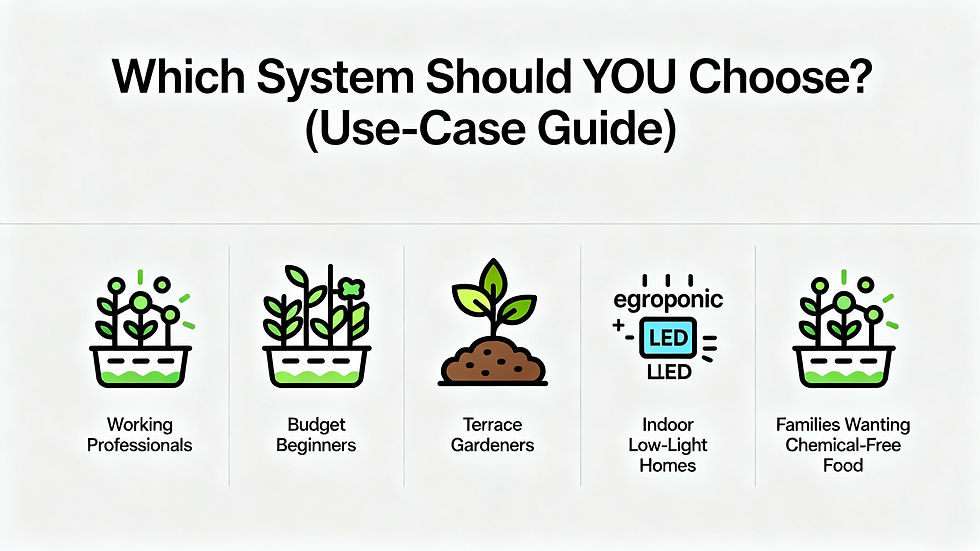
Which System Should YOU Choose?
Live in an apartment with no balcony → Aeroponics (space + low water use).
Budget beginner who wants to learn → Hydroponics (DWC/NFT/Kratky).
Terrace with full sun + large vegetable ambitions → Soil.
Want fastest harvests and don’t mind higher setup cost → Aeroponics.
Want low-tech, no power dependency → Soil or passive hydroponics (Kratky/wick).
Conclusion — Which system should you choose in 2025?
If you searched “hydroponics vs aeroponics” or “aeroponics vs hydroponics vs soil” to decide the best way to grow food at home in 2025, here’s the short, practical answer: choose the system that matches your space, budget, and time — but if you want maximum yield, lowest water use and minimal day-to-day mess, aeroponics is the winner for urban homes; if you want an affordable, forgiving start, hydroponics is best; and for large terraces or gardeners who prefer a natural approach, soil still makes sense.
Key takeaways:
Best for speed & efficiency: Aeroponics — fastest growth, lowest water use, ideal for apartments and busy professionals.
Best for beginners & cost: Hydroponics — easier to scale, lower upfront learning curve, good for leafy greens.
Best for variety & simplicity: Soil — cheapest setup, works for all crops but needs more space, pest care and watering.
If your goal is fast growth, clean produce, minimal maintenance, and long-term sustainability — aeroponics is the best home-growing system for 2025.
It offers unmatched efficiency, yield, cleanliness, and user convenience — especially for urban Indian households.


Comments