
Smart Gardening Is the Future of Home Farming. Here's What Pritam and Pedro Gets Right About Technology

Updated: Jul 27

When Pritam and Pedro, Rajkumar Hirani's cybercrime comedy drama on JioHotstar, premiered in July 2026, many conversations around the series focused on more than just its mystery. At its core, the story brings together two very different ways of solving problems: Pedro's years of practical experience and Pritam's confidence in modern technology. Rather than suggesting one approach is better than the other, the series makes a simple but powerful point. The best results often come when traditional knowledge works alongside intelligent tools.
That idea extends far beyond cybercrime investigations. It can be seen in healthcare, education, finance, transportation, and increasingly, in the way people grow food at home. This article is not a review of Pritam and Pedro. Instead, it uses one of the show's central ideas as a starting point to explore how technology is quietly transforming home gardening through innovations such as aeroponic towers and smart gardening systems.
There's a scene that keeps coming up in conversations about Pritam and Pedro — not one built around a plot twist, but around a quieter idea sitting underneath the story. Old skills don't disappear when new tools arrive. They get sharper. A craft that once depended entirely on instinct, patience, and trial and error becomes something more precise, more forgiving, more repeatable, once technology is allowed to sit alongside it rather than replace it.
It's a familiar idea once you notice it. Cooks still taste their food, but a thermometer tells them exactly when the protein is safe. Musicians still play by ear, but a tuner catches what the ear misses. Doctors still examine patients, but an MRI shows what a stethoscope never could. Technology, in each case, isn't cancelling out the old skill. It's removing the guesswork around it.
The same shift is quietly transforming another area of everyday life — one far removed from screens and streaming platforms, but arguably just as personal: how people grow food at home.
For decades, home gardening in India ran almost entirely on inherited knowledge. A grandmother's sense for when soil felt "right." A neighbor's tip about which corner of the balcony got enough sun. A lot of dead plants before anyone figured out the pattern. That kind of gardening still works, and for many people it still holds real value. But it's also becoming harder to practise in the exact conditions most urban Indians now live in — smaller floor plans, unpredictable weather, less free time, and soil that often isn't soil at all, just whatever came bagged from the nearest nursery.
This is where a new layer of technology has started to enter home gardening the same way a thermometer entered cooking: not as a gimmick, but as a way to remove uncertainty from something people already wanted to do. Sensors that track moisture. Systems that suspend roots in a fine, oxygen-rich mist instead of packing them into soil. Vertical structures that turn a two-foot balcony corner into a growing column with the output of a small garden bed. Collectively, this shift has a name — smart gardening — and it's worth understanding on its own terms, independent of any single show, trend, or brand.
Imagine Your Balcony Five Years From Now
Close your eyes for a moment and imagine stepping onto your apartment balcony on a Sunday morning. Instead of a row of plastic pots with dry soil, you see a vertical column of vibrant green vegetables growing neatly upward. Fresh coriander for today's dal. Mint for evening tea. Spinach for tomorrow's breakfast. Cherry tomatoes ripening naturally only a few feet away from your kitchen.
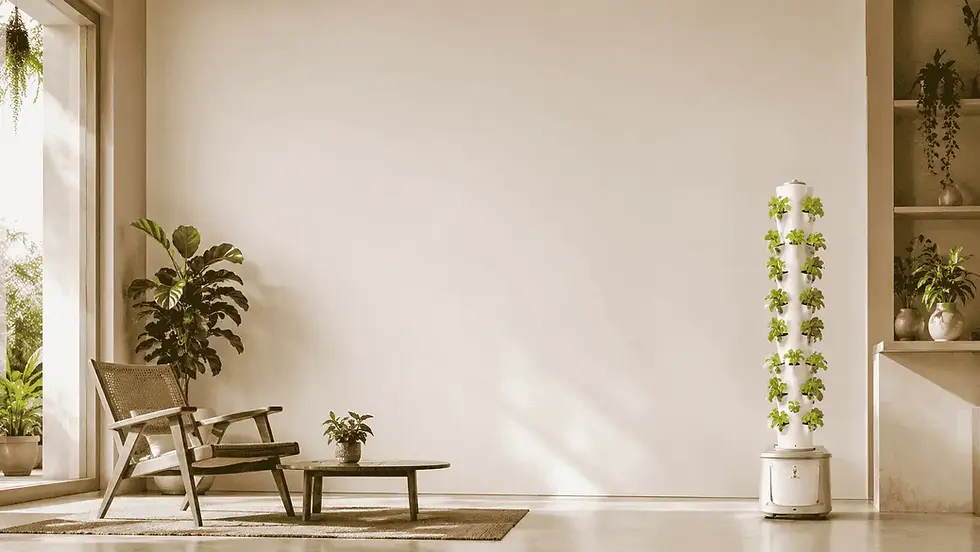
There is no muddy floor after heavy rain. No bags of soil stacked in the corner. No guessing whether yesterday's watering was enough. The system quietly takes care of the routine while you enjoy the rewarding part, watching healthy plants grow and harvesting exactly what you need.
A few years ago, this picture might have sounded futuristic. Today, thanks to advances in smart gardening, it is becoming an increasingly realistic option for urban Indian homes.
Technology Is Quietly Changing Everyday Life
It helps to zoom out first, because gardening isn't the only ordinary habit that's being reshaped in the background.
Consider how differently an average Indian household handles money today compared to a decade ago. Cash transactions have not disappeared, but a huge share of daily payments now move through UPI — a system so embedded in routine that a vegetable vendor accepting a QR code scan barely registers as remarkable anymore. Nobody consciously thinks of this as "adopting fintech." It's just how paying for sabzi works now.
The same quiet substitution has happened in navigation. Fewer people memorise routes or stop to ask for directions; a phone reroutes around traffic in real time, using data most drivers never think about. Healthcare has followed a similar arc — wearable devices track heart rate and sleep patterns continuously, catching irregularities that would once have gone unnoticed until a checkup, if they were noticed at all. Even something as basic as home security has shifted, with doorbell cameras and motion sensors doing quiet, constant work that used to depend entirely on a person being alert at the right moment.
Agriculture, at a much larger scale, has been going through its own version of this. Precision farming tools — soil sensors, satellite imagery, automated irrigation — are increasingly used by Indian farmers to reduce water waste and predict yield more accurately, particularly in water-stressed states. None of this technology replaces farming knowledge built over generations. It just removes some of the blind spots that used to make farming riskier than it needed to be.
What connects all of these examples is a pattern, not a gadget. Technology tends to succeed in daily life when it quietly reduces the guesswork in something people are already doing, rather than asking them to do something entirely new. Digital payments didn't invent the idea of paying for goods. Precision farming didn't invent agriculture. And smart gardening tools don't invent the desire to grow a tomato plant on a balcony — they just make it more likely that the tomato plant survives.
Practical takeaway: Before evaluating any "smart" home tool, ask a simple question — is this removing genuine uncertainty from a task I already do, or is it adding a feature I don't need? That question applies just as much to gardening tech as it does to fitness trackers or smart plugs.
Why Traditional Home Gardening Is Becoming Difficult
It's worth being honest about why so many well-intentioned attempts at home gardening in India quietly fail within a few months. The reasons aren't really about a lack of a "green thumb." They're structural.
Start with space. India's urban population crossed roughly 37 percent of the country's total population by the mid-2020s, and that share continues to climb as more people move into cities for work. Urban population growth in India has consistently run above two percent a year in recent readings, a pace that keeps pushing housing density upward, particularly in metros like Mumbai, Bengaluru, and Delhi NCR. As apartment sizes shrink and open plots vanish, the traditional idea of a "kitchen garden" with rows of vegetables in open soil simply doesn't fit most urban footprints anymore. A balcony, if there is one, is often the only outdoor surface a family has.
Soil quality compounds the problem. Much of the soil sold in urban nurseries is a generic potting mix, inconsistent in nutrient content and often already depleted after one or two growing cycles. Without regular testing or amendment — something few home gardeners have the tools or knowledge to do — plants in reused soil tend to grow weaker each season, not stronger.
Then there's water. India is home to roughly 18 percent of the world's population but has access to only about 4 percent of its freshwater resources, according to figures widely cited by government and research bodies tracking the country's water stress. Several major Indian cities have faced acute water shortages in recent years, with municipal supply restricted to fixed hours a day in parts of Chennai, Bengaluru, and Delhi during peak summer months. In that context, a hobby that traditionally involves generous, frequent watering of open soil beds is competing directly with a household's basic water needs — which is part of why so many gardening attempts quietly stop.
Climate adds another layer of unpredictability. Heatwaves have grown more intense and arrived earlier in the year across large parts of India, according to IMD data tracked over the past several summers, while monsoon patterns have become less consistent in both timing and intensity. Traditional gardening depended on somewhat predictable seasonal rhythms — sow before the rains, harvest before the heat. Those rhythms are shifting, and the margin for error has narrowed.
Finally, there's the plainest constraint of all: time. Working professionals in urban India, particularly those managing long commutes, are left with a narrow evening window for anything beyond basic chores. A garden that demands daily manual watering, pest checks, and soil monitoring is, for many households, simply incompatible with the hours actually available.
Expert insight: Agricultural extension researchers have long noted that most first-time home gardeners lose interest not because plants die from a single dramatic cause, but from a slow accumulation of small inconsistencies — a missed watering day here, an overwatered pot there. Removing that inconsistency, more than any single "hack," is what actually predicts whether a home garden survives its first year.
What Is Smart Gardening
"Smart gardening" is a broad umbrella term, and it's worth defining precisely rather than treating it as a buzzword. At its core, smart gardening refers to the use of sensors, automation, and engineered growing environments to reduce the guesswork and manual labour involved in growing plants, particularly in homes without access to traditional garden space.
It isn't one product. It's a spectrum of approaches, and different households will land at different points on it depending on space, budget, and how hands-on they want to be.
Automation is the simplest entry point — timers and controllers that handle watering schedules automatically, removing the risk of forgetting or overwatering. Even a basic drip-irrigation timer counts as a form of automation.
Sensors go a step further, actively measuring conditions like soil moisture, light levels, or nutrient concentration and adjusting inputs in response, rather than following a fixed schedule regardless of actual plant need.
Vertical gardening addresses the space problem directly. Instead of growing outward across a floor area, plants are grown upward in stacked or tiered structures, multiplying the number of plants that fit into a given footprint — a genuinely useful approach for apartment balconies with limited horizontal space.
Hydroponics removes soil from the equation entirely. Plant roots sit directly in a nutrient-rich water solution, which the plant draws from continuously. This solves the soil-quality problem outlined earlier, since the grower controls the nutrient content precisely rather than depending on whatever is in a bag of potting mix.
Aeroponics, which this article will examine in detail, takes the soil-free principle further still. Rather than submerging roots in water, aeroponic systems suspend roots in air and deliver nutrients through a fine mist, cycled at controlled intervals.
None of these approaches are mutually exclusive — a single home system might combine vertical structure, automated misting, and basic sensors. What unites them is the underlying goal: make plant growth less dependent on constant manual attention and inherited intuition, and more dependent on consistent, measurable conditions.
Smart Gardening: Myth vs Reality
As smart gardening becomes more popular, several misconceptions continue to discourage beginners from trying it. Separating fact from fiction helps make better decisions.
Myth | Reality |
Smart gardening is only for experienced gardeners. | Most modern systems are designed specifically for beginners with minimal gardening knowledge. |
You need a large terrace or backyard. | Many smart gardening systems are designed for balconies, rooftops, and even compact apartment spaces. |
Plants cannot grow properly without soil. | Plants need nutrients, water, oxygen, and light. Soil is only one possible growing medium. |
Aeroponic systems consume a lot of electricity. | Most home systems use only a small water pump that consumes relatively little power. |
Growing vegetables at home requires hours of work every day. | Automation reduces routine watering and nutrient delivery, allowing gardeners to spend more time enjoying the harvest than maintaining the system. |
The biggest misconception is that technology replaces gardening. In reality, it simply removes many of the repetitive tasks while leaving the enjoyable parts of gardening entirely in the gardener's hands.
What Is Aeroponics?
To understand why aeroponics has drawn so much research interest including from NASA, which has studied it since the 1990s for potential use in long-duration space missions it helps to understand the mechanism, not just the label.

Suspended roots- In an aeroponic system, a plant's root system hangs in an enclosed, dark chamber rather than being packed into soil or submerged in water. This might sound counterintuitive — roots are usually thought of as needing to be anchored in something. But roots don't actually need a solid medium to survive; they need access to water, nutrients, and oxygen. Suspending them in open air, rather than burying them, is what makes the next part possible.
Nutrient mist- At timed intervals — typically every few minutes, for a matter of seconds — a fine mist of water mixed with dissolved nutrients is sprayed directly onto the suspended roots. Because the droplets are extremely small, they coat the root surface almost like condensation rather than pooling around it. This means every root gets even, direct contact with the nutrient solution, rather than depending on nutrients diffusing slowly through soil, which is often uneven and depends heavily on soil structure.
Why oxygen matters- This is the mechanism that most explains aeroponics' effectiveness. In soil, roots are partially starved of oxygen simply because soil particles physically block airflow, especially in compacted or overwatered pots. In water-based hydroponics, roots sit fully submerged, which also limits the oxygen available to them unless the system is actively aerated. In an aeroponic chamber, roots spend the vast majority of their time surrounded by air, with oxygen freely available between misting cycles. Since root respiration — the process by which roots take in oxygen and release energy for growth — is a major driver of how fast a plant develops, this constant oxygen access is a large part of why aeroponically grown plants tend to develop faster and denser root systems than soil-grown equivalents.
Why water consumption decreases- Because nutrients are delivered as a fine mist directly to the root surface, almost nothing is lost to runoff, evaporation from surrounding soil, or absorption by non-root material. Water goes essentially where it's needed and nowhere else. Research associated with NASA's aeroponics programme has recorded water-use reductions of up to 98 percent compared with conventional soil-based growing, alongside notable reductions in fertilizer use, since nutrient delivery is similarly targeted rather than dispersed across a large volume of soil.
Soil vs Hydroponics vs Aeroponics
Factor | Soil-Based | Hydroponic | Aeroponic |
Growing medium | Soil or potting mix | Water with dissolved nutrients | Air, with nutrient mist |
Root oxygen access | Limited, depends on soil compaction | Moderate, needs active aeration | High, roots exposed to air between mist cycles |
Water usage | High, much lost to evaporation and runoff | Moderate, water is recirculated | Very low, mist is targeted directly at roots |
Nutrient control | Difficult to measure or adjust precisely | Precise, dissolved in water | Precise, dissolved in mist |
Space efficiency | Low, requires horizontal soil beds | Moderate | High, suits vertical and compact structures |
Pest risk | Higher, soil can harbour pests and fungal spores | Lower | Lowest, no soil medium for pests to establish in |
Maintenance | High, manual watering and soil monitoring | Moderate, requires monitoring water and pump | Low to moderate, mostly automated once set up |
Indoor suitability | Low, soil is messy indoors | Moderate | High, clean and enclosed system |
Benefits of Aeroponic Gardening
Each of these benefits is worth explaining in terms of the mechanism behind it, rather than as a standalone claim.
Water efficiency- As explained above, this comes from targeted mist delivery rather than broad application across a soil bed. In a country where several major cities restrict municipal water supply to a few hours a day during summer, a household growing method that uses a fraction of the water traditional gardening requires isn't a minor convenience — it's often the difference between a garden surviving the dry season or not.
Space efficiency- Because aeroponic towers are typically vertical rather than horizontal, the same floor footprint that would support two or three soil pots can support ten to twenty plant sites stacked along a column. This directly addresses the apartment-balcony constraint discussed earlier, where horizontal space is the scarcest resource in a home.
Faster growth- This follows from the oxygen mechanism described above — roots with constant access to oxygen typically support faster above-ground growth, since more of the plant's energy can go toward leaf and stem development rather than struggling to extract oxygen from compacted soil. NASA-associated research has reported notably higher biomass yield in aeroponically grown plants compared with soil and hydroponic equivalents over the same growing period.
Reduced pests- Most common household plant pests — soil gnats, root aphids, certain fungal pathogens — depend on a soil medium to establish and spread. Removing soil from the system removes the environment those pests need, which is why aeroponic setups tend to see meaningfully fewer pest issues without any pesticide use at all.
Cleaner gardening- This is a practical, not just aesthetic, benefit. Soil-based indoor gardening tends to mean spilled potting mix, water stains, and the general mess that makes many apartment dwellers reluctant to bring a garden indoors in the first place. An enclosed, soil-free system removes most of that friction, which matters more than it might initially seem for whether a gardening habit is sustained past the first few weeks.
Indoor suitability- Combining the above — lower mess, lower pest risk, and a compact vertical footprint — aeroponic systems are far better suited to indoor or semi-indoor placement (a balcony, a covered veranda, a well-lit room corner) than traditional soil gardening, which generally needs to stay outdoors.
Actionable takeaway: If you're evaluating whether any home growing system is worth the upfront setup, ask specifically which of these mechanisms — oxygen access, targeted water delivery, vertical space use — actually applies to the product in front of you. Not every soil-free system delivers all of them equally.
Best Vegetables and Herbs for Indian Homes
Not every crop is equally suited to a beginner's first attempt at smart or aeroponic gardening. The following tend to perform well for new growers in Indian household conditions, largely because they're forgiving of minor fluctuations in light or nutrient timing and have relatively short growth cycles, which means mistakes get corrected quickly rather than compounding over months.

Mint (Pudina). Naturally vigorous and fast-spreading even in soil, mint adapts easily to soil-free systems and tolerates minor care lapses well, making it one of the most forgiving starting herbs.
Coriander (Dhania). A kitchen staple with a genuinely short harvest cycle, coriander responds well to consistent moisture, which aeroponic misting delivers by design rather than by memory.
Spinach (Palak). Shallow-rooted and fast-growing, spinach suits vertical systems particularly well since it doesn't need deep root space to thrive.
Lettuce. A common first crop in soil-free systems worldwide, lettuce has a short growing cycle and gives new gardeners a fast, visible sense of progress — useful for building confidence early.
Basil (Tulsi and sweet basil varieties). Basil generally does better with consistent root oxygen than in dense soil, and its aromatic oils tend to develop well under stable growing conditions.
Fenugreek (Methi). Grows quickly from seed and tolerates the compact vertical spacing of tower systems, making it a practical choice for households that use methi leaves regularly in cooking.
Cherry tomatoes. A slightly more advanced choice, cherry tomatoes benefit strongly from the consistent nutrient delivery of aeroponic systems, since irregular feeding is one of the most common reasons tomato plants underperform in traditional pots.
Chillies. Compact varieties adapt well to vertical tower spacing and, like tomatoes, tend to reward the steady nutrient access that automated systems provide over manual watering schedules.
Beginners are generally better served starting with leafy greens and herbs — spinach, coriander, mint, basil — before moving on to fruiting plants like tomatoes and chillies, which demand slightly more attention to light and pollination.
Who Should Consider an Aeroponic Tower?
Aeroponic gardening is not designed to replace every form of gardening, nor is it the ideal solution for every household. Understanding where it fits best helps set realistic expectations.
An aeroponic tower may be an excellent choice if you are:
✅ Living in an apartment with limited gardening space.
✅ Looking to grow fresh herbs and leafy vegetables throughout the year.
✅ Concerned about water consumption.
✅ Interested in cleaner, soil free gardening.
✅ A working professional who prefers low maintenance gardening.
✅ Someone who enjoys using modern technology to simplify everyday tasks.
Traditional soil gardening may still be the better option if you:
❌ Have access to a large backyard with fertile soil.
❌ Primarily want to grow large fruit trees or extensive root vegetables.
❌ Prefer conventional gardening as a recreational outdoor activity.
Neither approach is inherently superior. They simply solve different problems for different lifestyles.
Choosing the Right Home Aeroponic System
Interest in soil-free and vertical growing has grown steadily in India over the past few years, and a handful of companies — some focused-on hydroponics, some on aeroponics specifically, some on hybrid vertical systems — have begun building products aimed squarely at the urban home gardener rather than commercial farms. The right choice for a given household usually comes down to available space, household size, and how much of a learning curve someone is willing to take on.
One example is Phooldaan, an Indian company building aeroponic tower systems designed specifically for home use. Its Nova range spans a few different sizes, which is worth understanding in terms of who each is likely to suit rather than as a sales pitch.
The Nova 20 is built for compact spaces — a small balcony or a single windowsill setup — and suits someone testing out aeroponic gardening for the first time without committing significant floor space. The Nova 35 sits a step up, offering more growing sites for a household that wants a slightly wider variety of herbs and greens running at once. The Nova 40 is aimed at households with a bit more balcony or terrace area who want a fuller mix of vegetables and herbs growing simultaneously. The Nova 120, considerably larger, is positioned for households or small community setups wanting a more substantial growing operation — closer to a genuine kitchen-garden replacement than a starter project.
Sizing a system correctly matters more than any single feature comparison. A larger tower in a small balcony often goes underused, while a small tower in a household that cooks with fresh greens daily may need topping up with produce sooner than expected. It's worth measuring available space and being realistic about weekly vegetable consumption before choosing a tier, regardless of which company's system a household eventually goes with.
Five Questions to Ask Before Buying Any Aeroponic System
Not every gardening system suits every household. Before investing in an aeroponic tower, it helps to answer a few practical questions.
1. How much space do I actually have?
Measure your available balcony, terrace, or indoor growing area before selecting a system.
2. What do I want to grow?
Leafy greens and herbs require different growing capacity compared to tomatoes or chilies. Your choice of crops influences the size of the system you need.
3. How much fresh produce does my family consume?
A household that cooks with fresh herbs every day will have different requirements from someone growing vegetables as a weekend hobby.
4. How much time can I realistically spend on gardening?
While aeroponic systems automate many routine tasks, they still require occasional cleaning, nutrient preparation, and monitoring.
5. Will the system receive enough sunlight?
Most edible plants require several hours of adequate sunlight every day. Understanding your home's natural lighting conditions is just as important as selecting the right equipment.
Answering these questions first often leads to a better long term experience than simply choosing the largest or most feature rich system available.
Future of Smart Gardening in India
Home aeroponic towers are a small piece of a much larger shift already underway in how India thinks about growing food close to where people live.
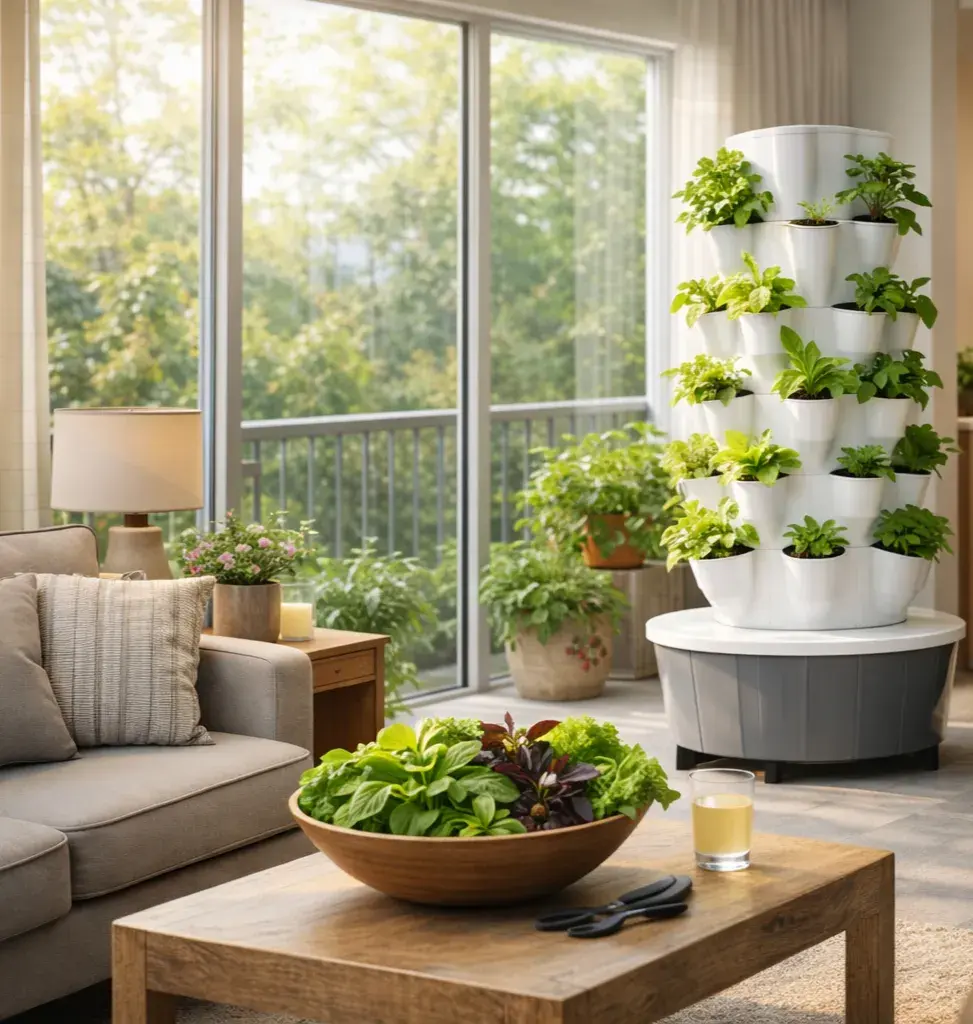
Urban farming initiatives have expanded in several Indian cities over the past decade, with municipal and state programme in places like Delhi, Bengaluru, and Pune experimenting with rooftop gardens, community farming plots, and subsidies for home growing equipment, partly as a response to food security concerns tied to rising urban populations. As India's urban population continues climbing past its current share of roughly 37 percent of the country's total, the pressure on peri-urban agricultural land is only expected to grow, making hyper-local food production — even at the scale of a single household balcony - a more meaningful contributor to food access than it might have seemed a decade ago.
Water scarcity, discussed earlier in the context of individual households, is also a macro policy concern. Government bodies including the Ministry of Jal Shakti have pushed water-efficient agricultural practices as part of broader water conservation strategy, and soil-free growing methods that use a fraction of traditional irrigation water fit squarely within that push, even at domestic scale.
There's also a self-reliance thread running through this shift. Consumer interest in traceable, pesticide-free food has grown noticeably in urban India in recent years, driven partly by concerns about chemical residue in commercially farmed produce and partly by a broader post-pandemic interest in home self-sufficiency. Growing even a portion of one's own herbs and greens — verifiably free of pesticide, picked the same day it's cooked — appeals to that instinct directly.
None of this suggests soil-based gardening or large-scale commercial farming is going away; both will remain essential. But smart, soil-free, space-efficient growing is increasingly positioned as a complementary layer sitting on top of India's existing food system — one more suited to the realities of apartment living, tightening water budgets, and shrinking free time than the gardening habits of a generation ago.
The First Harvest Is What Changes Everything.
Most people assume the biggest advantage of home gardening is saving money. In reality, experienced gardeners often describe something much simpler.
It is the moment of harvesting the first plant.
Picking fresh coriander minutes before preparing lunch. Cutting basil leaves while making homemade pasta. Watching children discover that vegetables grow on living plants rather than supermarket shelves. These experiences create a connection with food that cannot be measured in kilograms or rupees.
Technology plays only a supporting role in that experience. Whether the plants grow in soil, water, or an aeroponic tower, the real reward is the same: knowing exactly where your food came from and enjoying the satisfaction of growing it yourself.
Perhaps that is the most meaningful lesson behind both smart gardening and the broader idea explored in Pritam and Pedro. Technology does not replace human effort. It simply makes meaningful experiences easier to achieve.
Conclusion
Come back to where this piece started: the idea, borrowed loosely from the spirit of Pritam and Pedro, that technology rarely replaces skill or tradition outright. It tends to sit alongside it, absorbing the parts of a task that were always more about guesswork than genuine expertise, and freeing up attention for the parts that actually matter.
That's really what's happening in home gardening right now. Nobody needs a sensor to appreciate the smell of fresh basil or the satisfaction of picking your own coriander for dinner. But a lot of people who wanted that experience gave up on it years ago, not because they lacked a green thumb, but because soil, water schedules, and unpredictable weather made it harder than it needed to be. Smart gardening — whether that means a simple irrigation timer or a full aeroponic tower — doesn't change why people want to grow their own food. It just removes some of the reasons they used to stop.
If you're considering starting, the most useful next step isn't picking a brand. It's comparing a few different aeroponic and hydroponic systems against your actual balcony space, your household's weekly vegetable habits, and how hands-on you want the process to be — and choosing the one that fits, rather than the one that's loudest.
About Author
Akshat Bisht is an aspiring economist and sustainability enthusiast who creates educational content on aeroponics, and urban farming.


Comments