
Football Went From Instinct to Science. Your Garden Can Too.

Updated: Jul 27
From Haaland's Norway to your balcony: why India's aeroponic towers use the same precision science as elite football. Grow lettuce in 21 days.
Why Millions Are Searching For Norway vs England Right Now
On Saturday night in Miami, a country of five million people is trying to do something it hasn't done in 28 years. Norway, back at a World Cup for the first time since 1998, is one win away from a semi-final. Standing in the way is England, and specifically Harry Kane, in a match that has turned into the most searched football fixture in India this week.
The reason it's landed so hard here has a name: Erling Haaland. Seven goals in four matches, a Golden Boot race he's currently third in behind Messi and Mbappe, and a run that includes knocking out five-time champions Brazil in the round of 16. Indian football forums, WhatsApp groups, and fantasy league chats have spent the last four days doing the same thing football fans everywhere are doing: trying to explain how a team nobody rated four weeks ago is suddenly two matches from a World Cup final.
The honest answer isn't magic. It's method. Modern international football, at Haaland's level, doesn't run on instinct anymore. Recovery protocols, sprint-load data, nutrient timing, even the exact minute a player is substituted, all of it is measured, modelled, and adjusted daily. Haaland's Manchester City career alone is built on a level of physical and nutritional precision that would have looked unrecognisable to a striker from the 1990s.
That idea, that performance now comes from precision rather than instinct, is not just a football story. It's quietly become the same story in home food growing, and almost nobody in India has connected the two yet.
Football Has Changed. Farming Is Changing Too.
Picture a football match from 1996. A striker in that era trained hard, ate what the club canteen served, and relied on natural talent to get through ninety minutes. There was no sprint-tracking vest, no real-time substitution data, no individualised recovery plan. Results were real, but they were inconsistent, and nobody could tell you exactly why a player had a great game on Tuesday and a poor one on Saturday.
Now look at a 2026 quarter-final squad. Every player's output is logged in real time. Recovery is scheduled to the hour. Nutrition is calculated to the gram, by body weight, by match load, by climate. The unpredictability hasn't disappeared, football is still football, but the variance caused by guesswork has been engineered out wherever possible.
Indian home gardening has been stuck in its 1996 phase for a long time. A pot of soil on a fourth-floor Mumbai balcony is subject to the same guesswork a 1990s footballer's diet was. Water goes in, and nobody quite knows how much reaches the roots versus how much evaporates in April heat or drains away in a July downpour. Nutrients are added by rough estimate, not measurement. Pests move in because compacted, overwatered soil is exactly the environment they prefer. The result, like that inconsistent 1990s striker, is a plant that does fine some months and inexplicably fails in others.
Aeroponic growing is the sprint-tracking vest of home food production. It doesn't remove the plant's need to do the work of growing, just like data doesn't run the ninety minutes for the footballer. What it removes is the guesswork sitting between input and outcome. Water, nutrients, and oxygen are delivered on a measured schedule instead of an estimated one, and the result is a plant that performs closer to its actual potential, consistently, rather than a plant that performs well only when the guesswork happens to go right.
Why Aeroponics Is The Sports Science Version Of Gardening
The comparison holds up because the underlying principle is identical in both cases: stop guessing, start measuring, and performance becomes predictable.
Precision nutrition
An elite footballer's meal plan is calculated by body composition and match schedule, not by what looks like a balanced plate. In an aeroponic tower, nutrient solution is mixed to a specific concentration, measured in parts per million with a TDS meter, and misted directly onto exposed roots at timed intervals. There's no soil chemistry standing between the nutrient and the plant, working out what the roots actually receive versus what a bag of fertiliser claims to contain.
Oxygen advantage
Recovery science in football is largely about getting oxygen back to fatigued muscle as efficiently as possible. Plant roots have the same dependency. In soil, oxygen reaches roots through gaps between particles, gaps that close the moment soil is compacted or overwatered, which describes almost every container garden in an Indian apartment. In an aeroponic tower, roots hang in open air with constant oxygen exposure. Root respiration never gets rationed, and neither does growth.

Higher yields
A club doesn't get more out of a player by working harder in an inefficient system, it gets more by removing the inefficiencies. The same logic shows up in the numbers: Phooldaan's internal testing on the Nova 20 recorded first lettuce harvest at 21 days from transplant, against 45 to 60 days for the same variety grown in soil.
Space efficiency
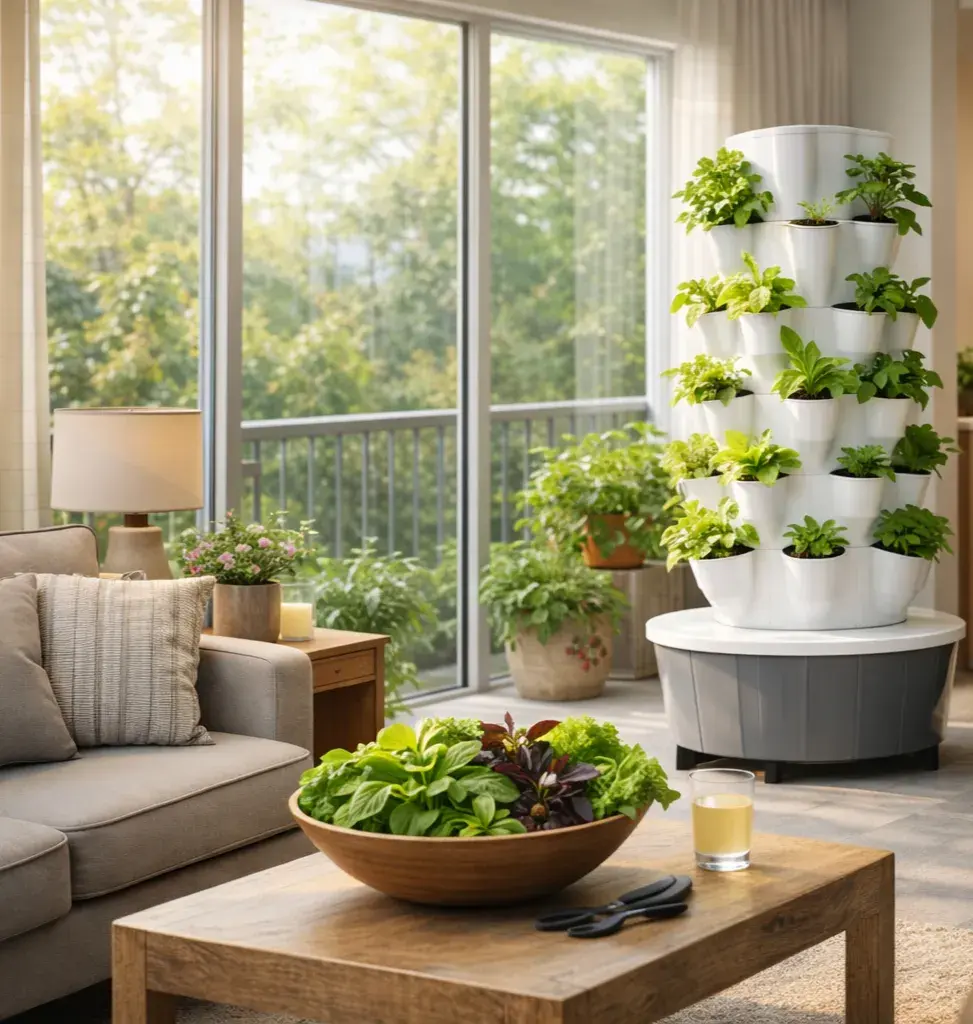
Modern squads are built around specialized roles in a fixed space, eleven players, one pitch, maximum output per position. An aeroponic tower applies the same logic vertically. The Nova 20 grows 20 plant sites in a 30cm by 30cm footprint, smaller than a standard floor fan, by stacking growing points up instead of spreading them out.
Water efficiency
India is among the most water-stressed countries in the world, and traditional agriculture already accounts for close to 80% of national freshwater use, much of it lost before it reaches a root. A closed-loop aeroponic system recirculates what isn't absorbed, cutting water use by up to 90% compared to the equivalent soil-grown crop. A Nova 20 with its 15-litre reservoir typically needs refilling once every four to five days for leafy greens, and every two to three days at the height of summer.
If Elite Footballers Grew Their Own Food, What Would They Grow?
Elite athletes eat for recovery and performance: lean proteins, and a heavy, consistent rotation of leafy greens and fresh herbs, exactly the crop category aeroponic towers are built for.
Take lettuce, the most aeroponic-optimised crop there is.
Growing Method | Days to First Harvest | Water Use | Pesticide Exposure |
Soil (balcony pot) | 45–60 days | High, most lost to evaporation and runoff | Common, soil is a pest vector |
Phooldaan Nova 20 (aeroponic) | 21–25 days | Up to 90% less, closed-loop recirculation | None, no soil, no pest vector |
Spinach follows a similar pattern, reaching a first full cut in 25 to 30 days. Coriander, grown from a germination tray, hits usable size in 18 to 22 days, faster than most home growers expect, and solves the specific Indian kitchen problem of buying bundles that wilt within 48 hours. Mint, once established, can be partially harvested every two to three weeks for months from a single planting. Basil takes four to six weeks to first harvest but keeps producing indefinitely if the upper leaves are cut regularly.
None of this requires the crop range of a commercial farm. It requires the crop range an Indian household actually cooks with every week.
The Goal To Grow Challenge
Here's a simple way to make this concrete instead of theoretical: plant before kickoff, harvest before the tournament ends.

The World Cup 2026 final is weeks away. A Nova 20 planted with lettuce or spinach today, at the quarter-final stage, will be ready for its first cut well before the trophy is lifted. It's a small, real deadline that turns “I should really try growing something” into a specific, trackable outcome, one you can post a photo of on the same week your football team plays its next knockout match.
Track it the way a club tracks form: day 1 sowing, day 10 root establishment (mostly invisible progress, the way pre-season conditioning is), day 14 visible growth acceleration, day 21 first harvest. Same shape as a knockout run, slow build, sudden payoff.
Which Phooldaan Tower Matches Your Squad?
Every squad has a formation that fits its personnel. Every household has a tower that fits its footprint.
Solo household or a couple wanting daily herbs → Nova 20
20 plant sites, 15-litre reservoir, 30cm × 30cm footprint. Built for first-time growers, balconies, and anyone who wants to test the system before scaling up. First lettuce harvest typically lands at 21 to 25 days.
Small family or terrace growers → Nova 40
40 plant sites, with a choice between a 20-litre reservoir for active growers who check in regularly, or a 60-litre reservoir for households who'd rather refill weekly than every few days. The standard recommendation for families of four or more looking to meaningfully cut down on produce shopping.
Large family, terrace farm, or small commercial ambitions → Nova 120
120 plant sites, run in staggered batches for a daily harvest rhythm rather than one large cut per cycle. Used by schools, restaurants, and corporate campuses, and the natural starting point for anyone thinking about a multi-tower setup.
Full specifications and side-by-side comparisons are on the Phooldaan Aeroponics pillar page, alongside the complete indoor gardening blog library.
The Future of Food Is Vertical
Every category eventually has a moment where the premium, engineered version stops looking like a luxury and starts looking like the obvious choice. Smartphones did it to phones. LED did it to lighting. Aeroponics is doing it to home food growing, not by rejecting gardening, but by applying the same precision-over-guesswork thinking that transformed elite sport to something as ordinary as a kitchen herb pot.
Phooldaan didn't build a nicer plant pot. It built a system engineered specifically for Indian conditions, food-grade UV-stabilised plastic that holds up through 45°C summers and monsoon humidity, a pump that costs roughly ₹65 to ₹90 a month to run, and a growing method backed by root-oxygenation research that traces back to NASA's original aeroponic experiments for space agriculture. The same instinct-to-data shift that turned Haaland into a data point as much as a talent is available on a Mumbai balcony for a few thousand rupees.
Norway didn't expect to be here. Most Indian households growing their own lettuce in three weeks didn't expect that either, until they measured instead of guessed.
Frequently Asked Questions
What is aeroponics and how does it work?
Aeroponics is a soil-free growing method where plant roots are suspended in air and fed nutrients through a fine mist, allowing direct oxygen and nutrient absorption for faster, more consistent growth than soil gardening.
Is aeroponics suitable for small Indian apartments?
Yes. Compact towers like the Nova 20 have a 30cm x 30cm footprint, smaller than most kitchen appliances, and are built for balconies, kitchen corners, and indoor spaces.
How fast can I harvest vegetables from an aeroponic tower?
Leafy greens like lettuce typically reach first harvest in 21 to 25 days, compared to 45 to 60 days in soil, with spinach at 25 to 30 days and coriander at 18 to 22 days.
How much water does an aeroponic tower use compared to soil gardening?
Aeroponic systems recirculate nutrient solution in a closed loop, using up to 90% less water than the equivalent soil-grown crop.
Which Phooldaan tower is right for my household?
The Nova 20 suits individuals and couples, the Nova 40 suits small families and terrace growers, and the Nova 120 suits large families, terrace farms, or small commercial setups.
About Author
Akshat Bisht is an aspiring economist and sustainability enthusiast who creates educational content on aeroponics, and urban farming.


Comments