
How Much Water Does an Aeroponic Tower Actually Save?

Updated: Aug 4
Water is the first question almost every new gardener asks about aeroponic towers, and it is also the question that decides whether the switch from a traditional bed or pot garden actually makes sense. The short answer is that a well run aeroponic tower can use up to ninety five percent less water than the same crop grown in soil. The longer and more useful answer is that the exact number depends on climate, crop choice, tower design, and how carefully the mist cycle is tuned, so it deserves a proper breakdown rather than a single headline figure.
This article walks through where traditional gardens actually lose their water, how an aeroponic tower like the ones in the Phooldaan range delivers moisture differently, and what the savings look like once you translate them into liters, buckets, and monthly water bills for a home in an Indian city. By the end you should be able to work out roughly how much water your own household would save by growing greens, herbs, and small vegetables in a tower instead of a bed or a row of pots.
What Makes Aeroponic Watering Different

Traditional gardening delivers water to the whole volume of soil around a plant, and the plant then draws out whatever fraction its roots happen to reach. Aeroponics skips the soil altogether. Roots hang inside an enclosed chamber and are misted directly with a fine spray of water carrying dissolved nutrients, on a timed cycle that might run for a few seconds every few minutes. Because the mist lands only on the roots that need it, almost none of the water is given to soil particles, air pockets, or the surrounding ground that a plant was never going to use in the first place.
This distinction matters more than it sounds. In a soil bed, a large share of every watering session is absorbed by soil that has no root activity nearby, or evaporates from the surface before a plant can use it at all. In an aeroponic tower, the chamber is sealed, so there is no exposed soil surface to dry out and almost no space for water to travel through and be lost along the way. The plant is essentially handed exactly the amount of moisture its roots can absorb, in the form its roots can absorb it fastest, which is why so little needs to be added in total.
Where Traditional Gardens Actually Lose Their Water
To understand the size of the savings, it helps to look at where a traditional garden's water goes once it leaves the hose or the watering can. Four losses account for most of it.
Surface evaporation is the biggest one. Soil left open to sun and moving air loses moisture from its top layers constantly, and in a hot Indian afternoon this can account for a large share of a day's watering before any plant root has touched it. Deep percolation is the second loss, where water travels past the root zone into deeper soil layers that the plant cannot reach, particularly in sandy or loose potting mixes. Runoff is the third, happening whenever water is added faster than the soil can absorb it, so it simply flows off the surface and out of the pot or bed. The fourth and often overlooked loss is what gardeners call overwatering as insurance, where people add extra water because they cannot see how much moisture is actually near the roots, so they water heavier and more often than the plant strictly needs, just to be safe.
None of these four losses are failures of the gardener. They are simply the nature of soil as a watering medium. Soil is excellent at many things, including buffering nutrients and supporting microbial life, but it was never an efficient water delivery mechanism, because most of the water added to it is never touched by a root at all.
The Numbers: Aeroponic Tower vs Soil Garden vs Drip Irrigation
Research on soilless growing methods, including studies referenced by NASA in its early aeroponics work for space agriculture, has repeatedly found water use reductions in the range of ninety-to-ninety five percent when aeroponics is compared against conventional soil based growing for the same crop and yield. Drip irrigation, which is already considered an efficient method compared to hand watering or flood irrigation, still falls well short of aeroponic efficiency because it delivers water to the soil around the root zone rather than directly to the root surface itself.
The table below gives a general comparison of how much water each method typically needs to grow a similar volume of leafy greens or herbs over a full growing cycle. These are illustrative ranges rather than fixed numbers, since actual figures shift with climate, crop, and system design, but they show the relative gap clearly.
Growing Method | Typical Water Use | Main Source of Loss |
Hand watered soil bed or pots | Highest baseline, treated as one hundred percent | Evaporation, runoff, deep percolation |
Drip irrigation in soil | Around forty to sixty percent of the baseline | Some evaporation, some percolation past roots |
Hydroponic systems (soilless, water based) | Around ten to twenty percent of the baseline | Occasional system flushing and evaporation from open reservoirs |
Aeroponic tower (sealed root chamber, misting cycle) | As low as five to ten percent of the baseline | Minor evaporation inside the chamber and periodic reservoir top ups |
A Real-World Calculation for an Indian Household
Numbers become more useful once they are turned into something a household can picture. Take a modest kitchen garden growing a mix of leafy greens, herbs, and a few fruiting vegetables in floor pots or a small bed. A household maintaining this kind of setup through a typical Indian summer might use anywhere from fifteen to twenty-five liters of water a day across the whole garden, once evaporation and the habit of watering generously in the heat are accounted for. Over a thirty-day month, that adds up to somewhere between four hundred fifty and seven hundred fifty liters just to keep a modest patch of plants alive.
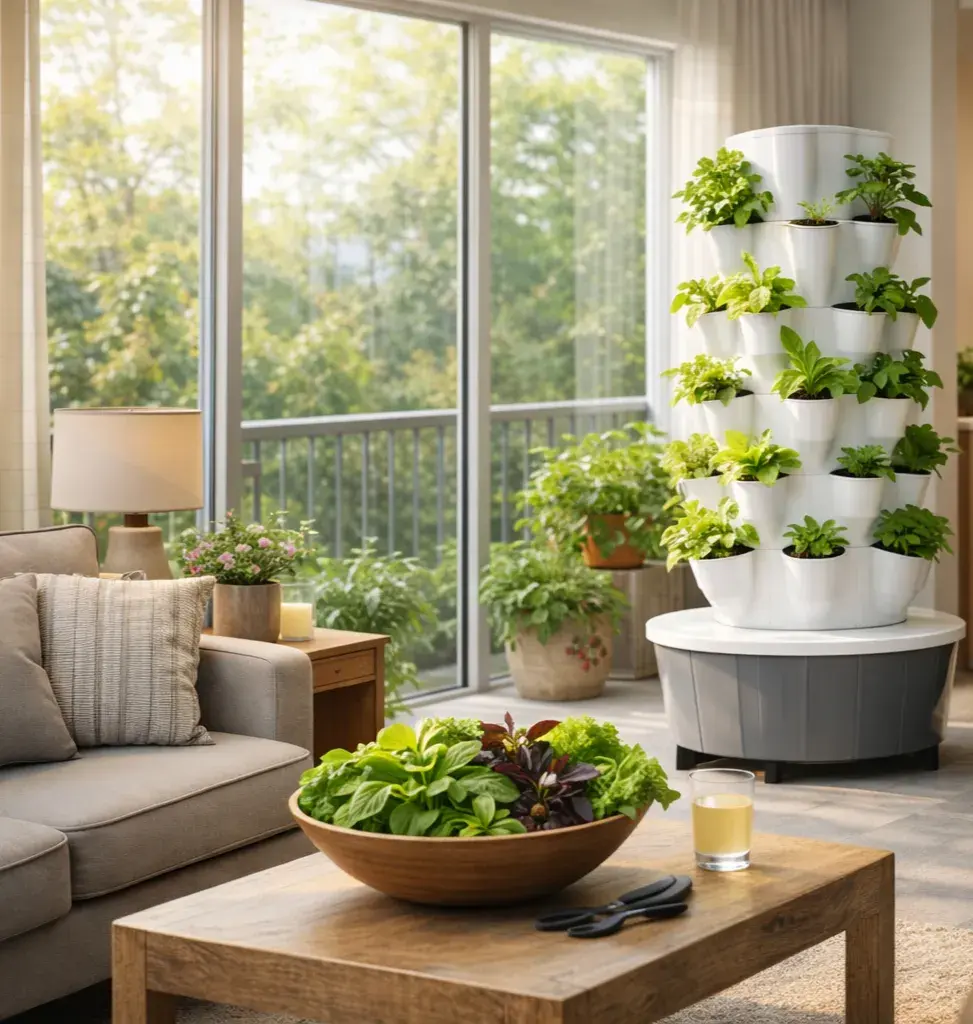
An aeroponic tower growing a comparable number of plants, using the misting cycles built into systems like the Nova 20 or Nova 35, typically needs only a small reservoir refill every few days rather than daily watering, because the closed chamber recirculates almost everything it uses. A household running one of these towers for the same mix of greens and herbs commonly reports monthly water use in the range of thirty to sixty liters, which is roughly a tenth of what the same growing volume would need in soil.
For a larger household or a small terrace setup running something like the Lotus 60 or Nova 120 to grow a wider variety of vegetables, the absolute liters used will be higher simply because the tower is bigger and holding more plants, but the ratio holds. The tower will still use a small fraction of what an equivalent soil garden of the same plant count would require, month after month, for as long as the system runs.
Why the Closed System Changes Everything
The core reason aeroponic towers save so much water comes down to three design features working together.
First is the sealed root chamber. Because roots are enclosed rather than exposed to open air and sun, there is no surface for water to evaporate from between misting cycles, which removes the single largest source of loss in a soil garden entirely.
Second is recirculation. Water that the plant does not immediately absorb during a misting cycle drips back down into a reservoir at the base of the tower rather than draining away into the ground or off the sides of a pot. That same water is then reused in the next cycle, so very little of what entersthe system is ever truly lost, it simply keeps circulating until the plant actually needs it.
Third is precision timing. Misting cycles are set to run for short bursts at intervals matched to what the plant's roots can absorb, rather than following a fixed daily schedule regardless of need. A gardener watering a pot by hand cannot easily judge exactly how much moisture is already present near the roots, so the natural response is to water a bit extra to be safe. A tower's timed misting removes that guesswork, delivering close to the exact amount the roots can use and nothing more.
Beyond Water: Other Resources an Aeroponic Tower Saves
Water is usually the headline number, but the same closed and precise design saves other resources too, which is worth knowing if efficiency, not just water, is the goal.
Fertilizer and nutrients are used far more efficiently, since the nutrient solution is dissolved directly into the misted water and delivered straight to the roots, rather than being spread across a volume of soil where much of it can bind to soil particles or wash away before a plant can absorb it. Growers commonly report needing noticeably less fertilizer per plant in an aeroponic tower compared to the same plant grown in soil.
Space is another major saving. A vertical tower like the Nova 40 grows dozens of plants in the footprint that a single soil bed would need for a handful of plants, which matters enormously on a city balcony or terrace where floor space is limited and every square foot has to earn its place.
Time is the third resource, since a tower on an automated misting cycle needs far less daily attention than a soil garden, which typically has to be watered by hand every morning or evening, checked for dryness, and adjusted constantly through changing weather.
Factors That Affect Your Actual Savings
The ninety-to-ninety five percent figure is a strong general benchmark, but a few factors will shift where your own garden lands within that range.
Climate plays a real role. In very hot and dry conditions, even a sealed tower will lose a little more water to evaporation from the reservoir itself and may need slightly more frequent top ups, though this is still minor compared to an open soil bed exposed to the same heat.

Crop choice matters too. Leafy greens and herbs, which have shallow and fast absorbing root systems, tend to show the highest percentage savings, while larger fruiting vegetables with more extensive root systems may show a somewhat smaller percentage savings simply because they need more total water regardless of the method used.
System maintenance is the final factor. A tower with a well sealed chamber and correctly tuned misting cycle will hit the higher end of the savings range, while a poorly maintained one with leaks or an oversized misting schedule will still save water compared to soil but by a smaller margin. This is one of the reasons it is worth choosing a tower built with tight seals and a properly engineered pump and timer, rather than an improvised setup.
Choosing the Right Tower for Your Water Goals
If reducing water use is the main goal, the size of tower you choose should match how much you actually intend to grow rather than the largest model available. A single person or couple growing herbs and a few leafy greens for daily cooking will see excellent savings from a compact system like the Nova 20, without paying for capacity they will not use. A family cooking for more people, or a household that wants a wider mix of vegetables through the year, will get better value and still enjoy the same percentage savings from a mid sized tower such as the Nova 35 or Nova 40. For a larger terrace setup feeding an extended household or supporting a small home business, the Lotus 60 or Nova 120 scale the same water saving design up to a much bigger growing volume.
Whatever the size, the underlying math stays consistent. The savings come from the design of the system, sealed roots, recirculated water, and precisely timed misting, not from the number of plants growing in it, so a bigger tower will simply save a bigger absolute number of liters while keeping the same efficient ratio.
Conclusion
The headline number is real. Aeroponic towers commonly use ninety to ninety five percent less water than the same plants grown in soil, and the reasons behind that number are straightforward once you see where traditional gardens actually lose their water in the first place. Evaporation from open soil, water draining past the root zone, runoff, and the natural habit of watering a little extra for safety together account for most of what a soil garden uses, and an aeroponic tower simply removes all four of those losses by keeping roots sealed, recirculating unused water, and misting on a precisely timed cycle.
For anyone gardening in a city with rising water costs and limited outdoor space, that difference adds up to real liters saved every month, alongside less fertilizer used, far less daily maintenance, and considerably more plants grown in the same square footage. Whether that means starting small with a compact tower for a kitchen's worth of herbs, or scaling up to a larger system for a full terrace garden, the resource efficiency scales with the setup while the water saving principle stays exactly the same.
Frequently Asked Questions (FAQs)
1. Does an aeroponic tower need any water at all once it is set up, or does it run completely dry between refills?
It still needs water, just far less of it and far less often. The tower holds a reservoir at its base that supplies the misting cycle, and this reservoir typically needs topping up every few days rather than daily, since most of the water misted onto the roots drips back down and gets reused rather than being lost.
2. Will an aeroponic tower save water in every climate, including very hot and dry regions?
Yes, though the exact percentage can shift slightly. In hot and dry regions, the sealed reservoir may lose a bit more water to evaporation and need slightly more frequent top ups, but this loss is still minor compared to how much water evaporates from an open soil bed exposed to the same heat, so the overall savings remain strong.
3. Do bigger plants like tomatoes or peppers save as much water as leafy greens in an aeroponic tower?
They save a large amount of water compared to growing the same plant in soil, though the percentage tends to be a little lower than what leafy greens show, simply because larger fruiting plants have bigger root systems and naturally need more total water regardless of the growing method used.
4. How much of the water saving actually comes from the tower's design versus how I use it?
Most of the saving comes from the design itself, since the sealed chamber, water recirculation, and timed misting cycle are what prevent the major losses seen in soil gardening. That said, a tower with a well sealed chamber and a correctly tuned misting schedule will land at the higher end of the savings range, while a poorly maintained one with leaks will still save water but by a smaller margin.
5. Can I calculate roughly how much water my own household would save by switching to an aeroponic tower?
You can get a reasonable estimate by tracking how many liters your current soil garden uses over a month and comparing that to the ninety to ninety five percent reduction range typical of aeroponic towers growing a similar number of plants. For most households growing herbs and leafy greens in floor pots or a small bed, this puts the monthly water use for an equivalent tower somewhere around a tenth of what the soil garden currently needs.


Comments