
Why Every Home Deserves a Buddha Statue


Walk into almost any home that feels calm the moment you step inside, and there is a good chance you will find a Buddha statue somewhere in that space. It might sit on a shelf near the entrance, rest quietly beside a cluster of plants on a balcony, or occupy a small corner table in the living room. For centuries, people across many cultures and faiths, not only Buddhists, have kept a Buddha statue at home. The reasons go far beyond decoration. A Buddha statue carries a quiet kind of presence that many people say changes the feel of a room the moment it is placed. If you have ever wondered whether adding one to your own home is worth it, or you already own one and want to understand why it seems to matter so much, this guide walks through the real, practical, and cultural reasons a Buddha statue earns its place in a home.
A Symbol Older Than Most Realize
The Buddha statue as we know it today did not exist during the lifetime of Siddhartha Gautama himself. Early Buddhist art avoided showing the Buddha in human form at all, choosing instead to represent his presence through symbols such as an empty throne, a wheel, or a set of footprints. It was only a few centuries later, as Buddhism spread across Asia through regions like Gandhara and Mathura, that artists began carving the Buddha as a person, seated in meditation or standing in blessing.
From there, the image traveled everywhere Buddhism traveled. Thai, Burmese, Tibetan, Chinese, Japanese, and Sri Lankan artisans each developed their own posture, expression, and style, yet the core idea stayed the same across all of them: a figure at complete peace, untouched by anger, greed, or fear. That is the quality people are really inviting into their home when they bring in a Buddha statue. It is not simply an old religious object. It is thousands of years of refined artistic effort aimed at capturing one single emotion, stillness.
A Daily Visual Reminder to Slow Down
One of the most practical reasons a Buddha statue works so well in a home has nothing to do with religion at all. It has to do with attention.
Most homes are full of objects that pull focus outward, screens, notifications, clutter, and to do lists left on the kitchen counter. A Buddha statue does the opposite. Its closed or half closed eyes, its relaxed shoulders, and its still hands are all visual cues for calm. Every time your eyes land on it, even for a second while walking past, your body tends to register that stillness and echo it slightly.
This is not just folklore. It works on the same principle behind mindfulness practice, where a single object or word is used as an anchor to bring attention back to the present moment. A statue placed where you naturally look throughout the day, near a doorway, on a work desk, or beside a reading chair, works the same way. It does not require you to sit and meditate for it to have an effect. It simply exists as a quiet checkpoint that reminds you to soften your shoulders, unclench your jaw, and take one slower breath before moving on with your day.
What Vastu and Feng Shui Say About Buddha Statues at Home
Two of the oldest systems of home design, Vastu Shastra from India and Feng Shui from China, both give the Buddha statue a meaningful place in the home, though for slightly different reasons.
In Vastu, the Buddha statue is considered a symbol of peace and positive energy, and it is often recommended for the living room, study area, or garden space, generally facing the main entrance so that its calming influence greets people as they arrive. It is typically advised to avoid the bedroom and the space directly above or below a toilet, since these are considered less suitable locations for a figure associated with spiritual energy.
Feng Shui treats the Buddha statue as a powerful symbol for inviting contentment, abundance, and protection into a space. A statue placed thoughtfully in the living room or entryway is believed to welcome good energy into the home, while one placed in a garden or balcony corner is thought to extend that same energy outdoors.
You do not have to follow either tradition strictly to benefit from the underlying idea both share, placement and intention matter. Choosing a spot for your statue deliberately, rather than setting it down wherever there happens to be free space, is itself a small act of mindfulness. For a full room by room breakdown of ideal Buddha statue placement, see our dedicated placement guide on the Phooldaan blog.
The Mental Calm Effect
There is a growing body of interest, both in psychology and interior design, around how the objects we surround ourselves with shape our mood over time. A cluttered, chaotic space tends to raise stress. A space with intentional, calming visual elements tends to lower it.
A Buddha statue is one of the most effective calming objects a home can hold, for a simple reason, its entire form is designed around serenity. The rounded shoulders, the soft facial expression, the symmetrical seated posture, all of these details were refined over centuries specifically to communicate peace. Unlike abstract art, which can be interpreted many ways, a Buddha statue carries one very clear emotional message.
Many people who keep a Buddha statue in a home office or study describe using it almost like a pressure valve during a stressful workday. A short glance at the statue during a difficult phone call or a tense deadline can interrupt a spiral of anxious thoughts, even briefly. Over weeks and months, that small pause, repeated often enough, becomes a genuine habit of returning to calm rather than staying stuck in stress.
A Quiet Anchor for the Whole Family
Homes with children, multiple generations, or frequent guests often benefit from having one object that everyone in the house recognizes as calm and grounding.
A Buddha statue in a shared space, such as a living room or family room, becomes a kind of neutral, peaceful landmark. It is not tied to any one person's schedule, mood, or opinion. Grandparents may see it as a spiritual object connected to their own upbringing. Children may simply learn to associate it with quiet moments, perhaps because they notice their parents pause near it. Guests, regardless of their own beliefs, generally read it as a sign of a thoughtful, intentional home.
This shared association matters more than it might seem. Homes accumulate emotional weight from arguments, deadlines, and daily friction. Having a visual constant that nobody disputes as calming gives a family a small, reliable place to return their attention when the day gets loud. It costs nothing to walk past it. It asks nothing of anyone. It simply sits there, holding the same expression it held yesterday and will hold tomorrow.

Aesthetic and Design Value
Set aside the symbolism for a moment and consider the Buddha statue purely as a design object. Few figures translate as well across design styles. A brass Buddha statue suits a warm, traditional living room filled with wood furniture and layered textiles. A pale stone or resin Buddha statue fits comfortably into a minimalist, neutral toned apartment. A weathered garden Buddha statue looks at home tucked among ferns, succulents, or the trailing greens of an aeroponic tower on a balcony.
This flexibility is part of why interior designers return to the Buddha statue again and again. Its form is simple enough to sit quietly in a busy room, yet detailed enough to serve as a genuine focal point in an otherwise minimal space. A single well chosen statue, positioned with a bit of empty space around it, can do more for a room's atmosphere than several smaller decorative pieces combined.
A Gift That Says Something
Buddha statues are also among the most thoughtful gifts a person can give, precisely because the object communicates a wish rather than an obligation. Gifting a Buddha statue for a housewarming, a graduation, a recovery from illness, or a retirement carries an implicit message, that you wish the person peace in this new chapter. That is a different sentiment than most gifts carry.
The size, posture, and material of the statue can be adjusted to suit the occasion and the relationship, something we cover in depth in our gifting guide. What matters here is simply this, very few objects manage to be decorative, meaningful, and universally appropriate all at once. A Buddha statue checks all three boxes, which is part of why it remains a popular gift across so many cultures and generations.
Pairing a Buddha Statue With Living Greenery
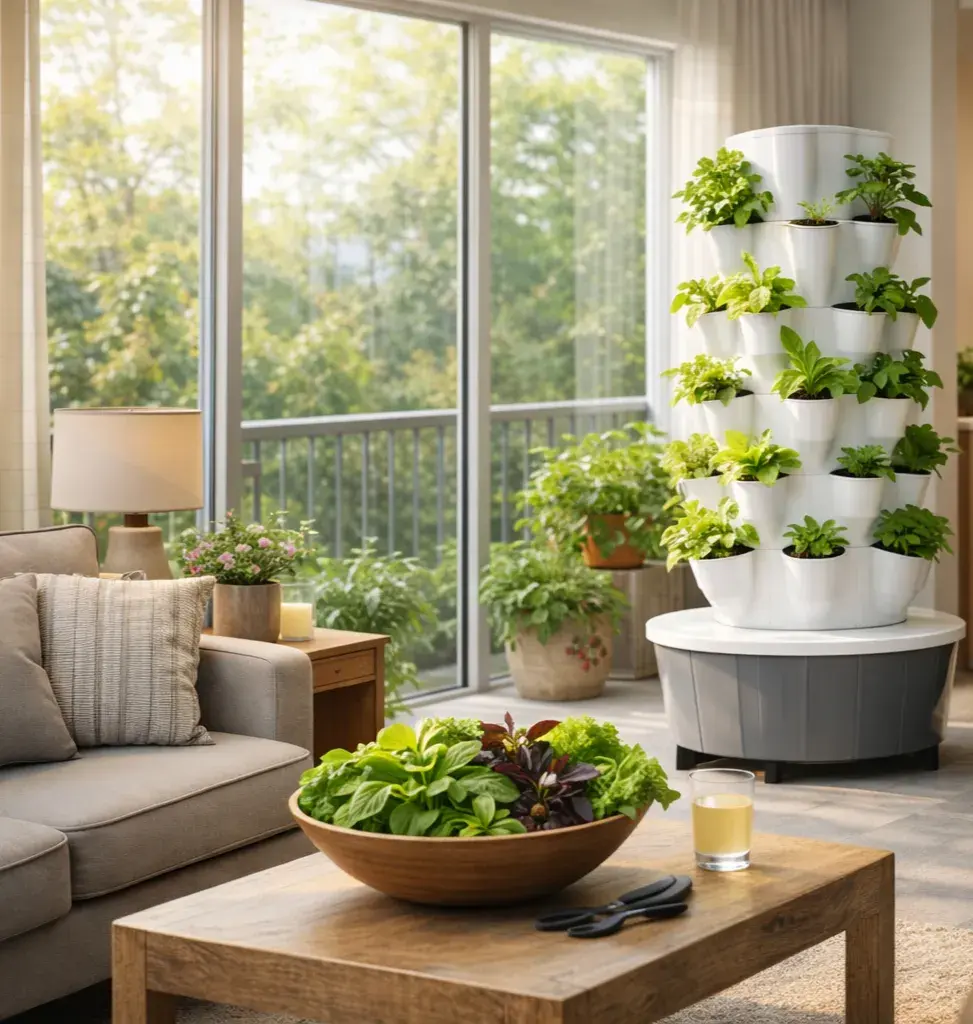
One of the most visually striking ways to display a Buddha statue at home is alongside living plants, and this is where a growing garden setup becomes especially rewarding. A Buddha statue placed near an aeroponic tower garden, whether on a balcony, terrace, or a quiet indoor corner, creates a small sanctuary that appeals to both the eyes and the mind. The statue provides the stillness, and the plants provide the life and movement, a pairing that feels balanced rather than static.
Towers growing herbs, leafy greens, or trailing vines around a seated Buddha statue also tend to soften the formality of the statue itself, making the whole corner feel less like a shrine and more like a natural extension of the home. If you are building this kind of corner yourself, our dedicated guide on pairing a Buddha statue with greenery walks through spacing, plant choices, and layout ideas in more detail.
Common Misconceptions Worth Clearing Up
A few misunderstandings keep some people from bringing a Buddha statue into their home, so they are worth addressing directly.
First, owning a Buddha statue does not require a person to practice Buddhism. Millions of homes across many faiths and no particular faith keep one purely for its symbolism of peace, patience, and calm.
Second, a Buddha statue is not considered bad luck if handled respectfully. The general guidance across most traditions is simply to keep it clean, place it at a reasonable height rather than on the floor, and avoid the bedroom, bathroom vicinity, and areas near shoes.
Third, an old or secondhand Buddha statue is not automatically inauspicious. Many people specifically seek out antique or well used statues, believing that the years of quiet presence add to, rather than diminish, the object's calming quality.
Choosing the Reason That Resonates With You
Not everyone brings a Buddha statue home for the same reason, and that is entirely fine. Some people are drawn to the spiritual symbolism, others to the design value, and others simply enjoy how the statue changes the mood of a room without effort. None of these reasons cancels out the others.
If you are considering your first Buddha statue, start with whichever benefit matters most to you personally, whether that is the calming visual anchor for a busy household, the design flexibility for a room you are decorating, or the meaningful gift for someone going through a big change. The statue tends to earn its place regardless of the reason that first brought it home.
Conclusion
A Buddha statue is one of the rare objects that manages to be spiritual, decorative, and genuinely useful all at once. It asks nothing of the people who live around it, yet it consistently offers something back, a visual pause, a design anchor, a shared point of calm for a whole household. Whether you place it near your morning tea, tuck it into a garden corner beside a growing aeroponic tower, or give it to someone stepping into a new chapter of life, a Buddha statue tends to reward the space it occupies. If you already have one, notice how often your eyes land on it during a difficult day. If you do not, this is likely the sign to change that.
Frequently Asked Questions (FAQs)
Do I need to be Buddhist to keep a Buddha statue at home?
No. A Buddha statue is kept by people of many faiths and no particular faith at all, purely as a symbol of peace, patience, and calm. In most homes it functions as a design and mindfulness object rather than a strictly religious one, though it is still worth treating it with basic respect.
Where should I avoid placing a Buddha statue?
Most guidance suggests avoiding the bedroom, the area directly facing a bathroom door, and low positions such as the floor or a spot near shoes. A raised, clean, and reasonably quiet corner of the living room, entryway, study, or garden tends to work best.
Does the direction the statue faces actually matter?
In Vastu and Feng Shui, yes, direction is considered part of how the statue's energy interacts with the home, and facing the main entrance is commonly recommended. If you are not following either tradition specifically, choosing a direction where the statue is easily visible from a spot you sit in often is a practical alternative.
Can I keep more than one Buddha statue in the same home?
Yes, many homes keep several, often in different rooms or in different postures and materials, such as a seated statue indoors and a standing or garden statue outdoors. There is no fixed limit, though each statue should still be placed thoughtfully rather than scattered without intention.
How do I pick the right size Buddha statue for a small apartment?
For small spaces, a compact tabletop statue between fifteen and thirty centimeters tall usually works better than a large floor piece, since it sits comfortably on a shelf, console, or windowsill without crowding the room. Our size guide breaks this down room by room in more detail.

Comments