
Aeroponic Tower Price in India: Full Cost Breakdown, Monthly Running Costs & ROI (2026)

Updated: Jul 27

An Aeroponic tower price in India starts at ₹3,400. But that single number answers less than half of your actual question.
What most Indian buyers really want to know is this: what does the thing cost to run every month? How soon does it pay for itself against your sabzi mandi bill? And which model is actually worth buying for a 2BHK in Bengaluru, a north-facing flat in Mumbai, or a terrace in Delhi?
This guide gives you honest, India-specific answers to all of those questions — with real rupee figures, not vague USD estimates converted from Western farming blogs.
Aeroponic Tower Price in India at a Glance (2026)
Model | Plant Slots | Tank | Price (₹) | Best For |
Nova 20 Planter | 20 | External bucket | ₹3,400 | Beginners, small balconies, herb gardens |
Nova 40 (20L tank) | 40 | 20 L | ₹4,000 | Medium balconies, families growing herbs + greens |
Nova 40 (60L tank) | 40 | 60 L | ₹5,400 | Less refilling, larger families, leafy vegetables |
Nova 35 (Indoor + LED Grow Lights) | 35 | Included | ₹6,600 | North-facing flats, monsoon season, no direct sunlight |
Nova 120 System | 120 | Included | ₹12,400 | Terrace gardens, large families, semi-commercial use |
Timer Add-on (all models) | — | — | +₹400 | Automates misting cycles, saves electricity |
What Makes Aeroponic Tower Prices Different?

1. Plant Capacity
More growing slots means more tower sections, more nozzles, and a more powerful pump. A 20-slot tower and a 120-slot system are fundamentally different hardware products. For most urban Indian families, 20–40 slots is the practical sweet spot.
2. Tank Size
Larger tanks mean less frequent refilling — important if you are frequently away from home or growing water-intensive crops. The Nova 40 comes in both 20L and 60L configurations. The 60L variant is worth the extra ₹1,400 if you want to top up water once a week rather than every 2–3 days.
3. Materials and Build Quality
Food-grade UV-stabilised plastic is non-negotiable for a tower that grows edible plants. It is also what separates ready-made aeroponic towers from DIY PVC builds — sourcing certified food-grade plastic locally in India is genuinely difficult. Cheaper listings on aggregator sites often do not specify material grade.
4. Pump and Nozzle Quality
The misting nozzle is the most failure-prone component in Indian conditions, primarily because of hard water. Delhi, Jaipur, Ahmedabad, and parts of Bengaluru have tap water TDS of 300–600 ppm. Standard nozzles clog within weeks. Purpose-built towers for Indian conditions use nozzles designed for this — a detail worth asking any supplier about before buying.
5. Grow Lights and Automation
The Nova 35 includes built-in LED grow lights specifically for apartments with limited sunlight. The ₹6,600 price point reflects both the hardware and the India-specific engineering for standard 220V supply with load-shedding considerations. The optional timer (₹400) is worth every rupee — it automates the pump cycle, reduces electricity consumption, and prevents overwatering.

Total Monthly Running Cost of an Aeroponic Tower in India
Cost Head | Monthly Estimate | Notes |
Electricity | ₹10 – ₹40 | Pump runs in short bursts; with timer this drops significantly |
Growing Media (Coco Discs) | ₹25 – ₹60 | Per planting cycle; reusable for 1–2 crops |
Liquid Nutrients | ₹80 – ₹150 | General hydroponics nutrient mix; 250ml concentrate lasts ~2–3 months |
Water | ₹0 – ₹30 | 90% less water than soil; most urban families notice negligible change on bill |
TOTAL MONTHLY COST | ₹115 – ₹280 | Average urban Indian household: ~₹180/month |
To put this in context: the average urban Indian household spends ₹2,000–₹4,500 per month on vegetables. Running an aeroponic tower costs less than a single kilo of good organic spinach from a premium supermarket.
One India-specific note on electricity: most aeroponic pump motors are rated at 5–25 watts and run in intermittent cycles rather than continuously. With a timer, the pump might run for 15–30 minutes every 2–3 hours. On Indian electricity tariffs (₹5–₹8 per unit), this works out to ₹10–₹40/month in most cities.
Return on Investment — Does an Aeroponic Tower Pay for Itself?
Scenario: A family of four in Bengaluru running a Nova 40 (₹4,000), growing dhaniya, pudina, palak, and lettuce year-round.
Parameter | Estimate | Basis |
Tower cost (Nova 40) | ₹4,000 | One-time hardware purchase |
Monthly running cost | ₹180 | Nutrients + electricity + media |
Dhaniya (50g/week saved) | ₹300/month | ₹15 per bunch × 4–5 bunches/week |
Pudina + Palak savings | ₹200/month | Conservative estimate |
Total monthly savings | ₹500 – ₹900 | Depending on what you grow |
Net monthly gain | ₹320 – ₹720 | After subtracting running costs |
Break-even period | 6 – 13 months | Most families hit it within 8 months |
A Bengaluru software professional we spoke to harvests roughly 150–200g of dhaniya every week from a Nova 40 tower — enough to eliminate their coriander purchases entirely. At ₹15–20 per bunch, that single herb saves ₹250–₹350 per month.

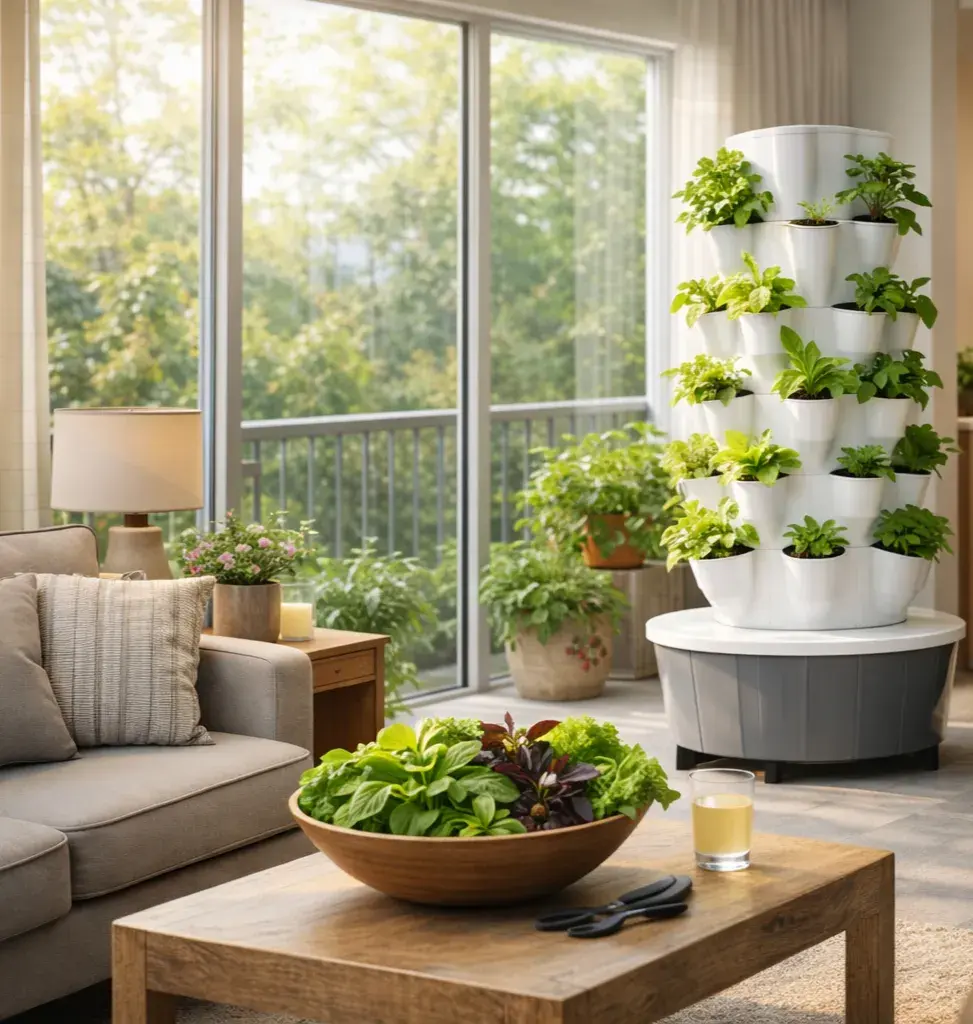
Nova 40 with 20l tank Aeroponics Tower, vertical garden system
Important caveats: savings depend heavily on what you grow and how consistently you maintain the tower. Herbs (dhaniya, pudina, basil, tulsi) give the best ROI per slot because they are bought frequently and have high market prices relative to their weight. Crops like tomatoes and chillies are possible on larger towers but require more patience and take longer to reach harvest.
Aeroponic Tower vs. Other Growing Methods — Price Comparison
Method | Setup Cost | Water Use | Monthly Upkeep | Verdict for Indian Homes |
Aeroponic Tower (Phooldaan) | ₹3,400 – ₹12,400 | Very low | ₹115 – ₹280 | Best for small spaces; fastest growth; least water |
Hydroponic NFT System | ₹5,000 – ₹20,000 | Low | ₹150 – ₹350 | Good yields; needs more horizontal space |
Soil pots (balcony) | ₹500 – ₹3,000 | High | ₹50 – ₹100 | Cheapest start; slow growth; pest-prone |
DIY Aeroponic (PVC) | ₹2,500 – ₹4,500 | Low | ₹100 – ₹250 | No warranty; hard water clogs PVC nozzles; food-grade plastic hard to source in India |
₹8,000 – ₹40,000+ | Very low | ₹300 – ₹600 | Adds fish care complexity; not suited for casual home use |
The DIY column deserves an honest note: many Indian home growers start by attempting a PVC aeroponic tower. The actual build cost — once you account for a reliable submersible pump, food-grade pipes, nozzles, and a proper reservoir — usually lands between ₹2,500 and ₹4,500. Without a warranty, technical support, or nozzles rated for hard water, the failure rate in Indian conditions is high. Most DIY builders who experience nozzle clogging or pump failure in the first monsoon season end up buying a ready-made tower anyway. For ₹3,400, Phooldaan's Nova 20 removes all of that uncertainty.

Which Aeroponic Tower Should You Buy? A Guide by Buyer Profile
Buyer Profile | Recommended Model | Why |
First-time grower, 1BHK balcony | Low commitment, easy to start; fits on a 2×2 ft balcony corner | |
Family of 4, 2BHK with south-facing balcony | 40 slots grows enough dhaniya, pudina and palak for daily cooking | |
North-facing flat or monsoon-heavy city (Mumbai, Kolkata) | Built-in grow lights eliminate dependence on sunlight | |
Health-conscious family growing microgreens + salads | Timer automates cycles; no babysitting the pump | |
Terrace garden / large family / urban homesteader | 120 slots means growing full meals — not just herbs |
Common Mistakes Indian Buyers Make Before Purchasing
1. Not Checking Their Tap Water TDS
This is the single most overlooked factor. If your municipal water supply has a TDS above 300 ppm (common in Delhi, Jaipur, Lucknow, and parts of Hyderabad), you need to flush the system with RO or filtered water at least partially, or clean nozzles monthly. Buy a cheap TDS meter (₹200–₹400 online) and test your tap water before you start. It takes two minutes and prevents most maintenance issues.

2. Buying Too Small for Their Actual Needs
The Nova 20 is an excellent starter tower. But a family hoping to meaningfully reduce their vegetable bill — not just grow a few herbs as a hobby — will find 20 slots limits what you can grow simultaneously. If your goal is genuine kitchen self-sufficiency, start with the Nova 40. The extra ₹600 is worth it.
3. Ignoring Sunlight Requirements Before Buying a Standard Tower
A standard tower (Nova 20, Nova 40, Nova 120) needs 4–6 hours of direct sunlight daily. If your balcony faces north, is shaded by adjacent buildings, or you live in Mumbai or Kolkata where monsoon cloud cover lasts from June through September, either plan for the Nova 35 with grow lights, or be prepared to supplement with a separate LED panel. Many buyers skip this check and are disappointed with slow growth during monsoon.
Buying with Confidence: Warranty, Support & Returns
Phooldaan is an Indian brand building for Indian conditions — hard water, load-shedding, monsoon humidity, and the specific vegetables Indian households actually cook with.
Warranty and returns: Phooldaan's return policy is customer-friendly and accommodates replacements for defective or damaged units.
Full terms are available at phooldaan.com/refund-policy.
Support: For pre-purchase questions, setup guidance, or post-purchase troubleshooting, reach the Phooldaan team directly on WhatsApp at +91 99873 00557. Response time is typically within a few hours on business days.
Price update commitment: Prices in this guide are verified as of May 2026. Phooldaan updates pricing periodically; always check phooldaan.com for the current live price before purchasing.

Ready to Start Growing?
The most popular starting point for Indian home growers is the Nova 40 with 60L tank (₹5,400) — 40 plant slots, a large enough reservoir to reduce daily maintenance, and a size that fits comfortably on most 2BHK balconies. Add the timer (₹400) and you have a fully automated home food system for under ₹6,000.
For apartments with limited sunlight, the Nova 35 Indoor (₹6,600) with built-in LED grow lights is the only ready-to-use indoor aeroponic tower available in India built for the Indian grid.
Frequently Asked Questions (FAQs)
What is the cheapest aeroponic tower in India?
A: The most affordable ready-to-use aeroponic tower in India currently starts at ₹3,400 (the Phooldaan Nova 20). DIY PVC builds can theoretically go lower but typically end up costing ₹2,500–₹4,500 once you account for food-grade materials, a pump, and fittings — without any warranty.
How much does it cost per month to run an aeroponic tower in India?
A: For a standard home tower, expect ₹115–₹280 per month covering electricity, nutrients, and growing media (coco discs). The pump uses minimal power — comparable to leaving a single LED bulb on. A timer reduces electricity costs further.
How long does it take for an aeroponic tower to pay for itself?
A: Most Indian households growing dhaniya, pudina, palak and lettuce report breaking even within 6–13 months. A family spending ₹2,500–₹3,500/month at the sabzi mandi typically saves ₹500–₹900/month from a 40-slot tower, bringing break-even under 8 months for the Nova 40.
Does an aeroponic tower work without sunlight in Indian apartments?
A: Standard towers need 4–6 hours of direct sunlight per day. If your flat is north-facing or gets limited sun (common in Mumbai high-rises and Kolkata flats), the Nova 35 with built-in LED grow lights is the better choice. LED running cost adds roughly ₹40–₹80/month to your electricity bill.
Is GST included in the aeroponic tower price shown on phooldaan.com?
A: Prices displayed on Phooldaan's product pages are inclusive of applicable taxes. Shipping charges, if any, are shown at checkout. For bulk or commercial orders, WhatsApp Phooldaan at +91 99873 00557 for a customised quote.
What is Phooldaan's return policy for aeroponic towers?
A: Phooldaan has a flexible, customer-friendly replacement policy. If you receive a damaged or defective unit, replacements are accommodated. Full details are available on the Phooldaan Refund Policy page (phooldaan.com/refund-policy). For any concerns, reach out on WhatsApp: +91 99873 00557.


From my perspective, this breakdown of aeroponic tower costs in India is precisely what I was looking for. It's genuinely refreshing to see the technology explained so clearly and accessibly, especially when considering the investment. My own journey with setting up an aeroponic system started quite similarly to the scenarios you've outlined, with a lot of initial research and uncertainty about the actual expenses involved. You've managed to capture that initial phase perfectly https://en.wikipedia.org/wiki/Bingo_(non-US) There's definitely so much more to unpack when it comes to the long-term viability and potential of these systems. It's not just about the upfront price, but also the ongoing operational costs and the eventual returns. I'm particularly interested in understanding how different environmental factors might…
This reads like a truly definitive guide to aeroponic towers, and I'm so glad I stumbled upon it. What really got my attention was how clear and concise all the information was, much obliged for that clarity. The core message about the efficiency and potential of aeroponic towers is absolutely spot on; it's something I've been considering for a while now for my small urban garden https://www.accc.gov.au/system/files/social-media-influencer-testimonials.pdf It’s exciting to think about the possibilities. On a related note, I feel inspired to explore the concept of aeroponic towers even more deeply. It seems like the next logical step after absorbing all this excellent foundational knowledge. On top of that, if you have any recommendations for resources or specific models that…